

History of Danish Windmills

From Grain to Grid

The story of Danish wind power is a millennium-long journey titled “From Grain to Grid”. It chronicles an incredible evolution where a nation of farmers and blacksmiths transformed their daily labor from grinding flour by hand into a global industry that powers the world with wind.

The Survival Bottleneck
Before the 1100s, human survival was strictly limited by the energy of human muscle. This period was defined by the “Hand Quern,” a stone tool that represented the ceiling of civilization’s energy budget, requiring hours of daily manual labor just to release nutrients from grain. This physical limit acted as a “survival bottleneck” for society.

The First Revolution
The first major leap occurred with the Cistercian monks, who introduced the vertical water wheel equipped with bucket paddles. This innovation meant that a single mill could do the work of 100 men. It also shifted the economy, introducing “The Mill Toll,” where payments were made to the King or Church in grain.

Unlocking the Wind
The “Post Mill” brought about a revolution by liberating energy production from riverbanks. By balancing the entire millhouse on a single post, the structure could be “wound” or rotated to face the wind, meaning power could finally be generated anywhere.

The Age of Gearing
The Dutch Mill introduced two critical mechanical advancements: “Cap-Only Rotation,” where only the roof turned (allowing for larger, stable towers), and sophisticated gearing ratios. The introduction of the spur wheel—the ancestor of the modern gearbox—allowed one rotor to drive multiple machines at once, increasing both torque and speed.

The Universal Machine
By the 1600s, windmills had evolved into the “Universal Machine,” serving as the industrial engines of the state rather than just food processors. These mills supported national defense by forging gun barrels, aided construction through sawmills, and supported the textile industry with fulling mills for cloth.

The Danish Edison
In 1891, a physicist and humanist named Poul la Cour acted as a pivotal figure in wind history. He was the first to shift the windmill’s purpose from mechanical torque (grinding) to the generation of electricity, with the specific goal of modernizing the rural countryside.

Cracking the Code of Aerodynamics
La Cour built the world’s first wind tunnel at Askov to experiment with aerodynamics. His research led to the counter-intuitive discovery that fewer blades spinning fast are more efficient than many blades spinning slow. He established the principle that modern turbines rely on “suction” (lift) rather than the “push” (drag) of the wind.

Taming the Storm
To solve the problem of traditional mills spinning out of control in high winds, the “Shutter Sail” was invented. This solution used spring-loaded flaps that would automatically blow open to let air pass through during storms, serving as the mechanical ancestor to modern pitch control and active stall regulation.

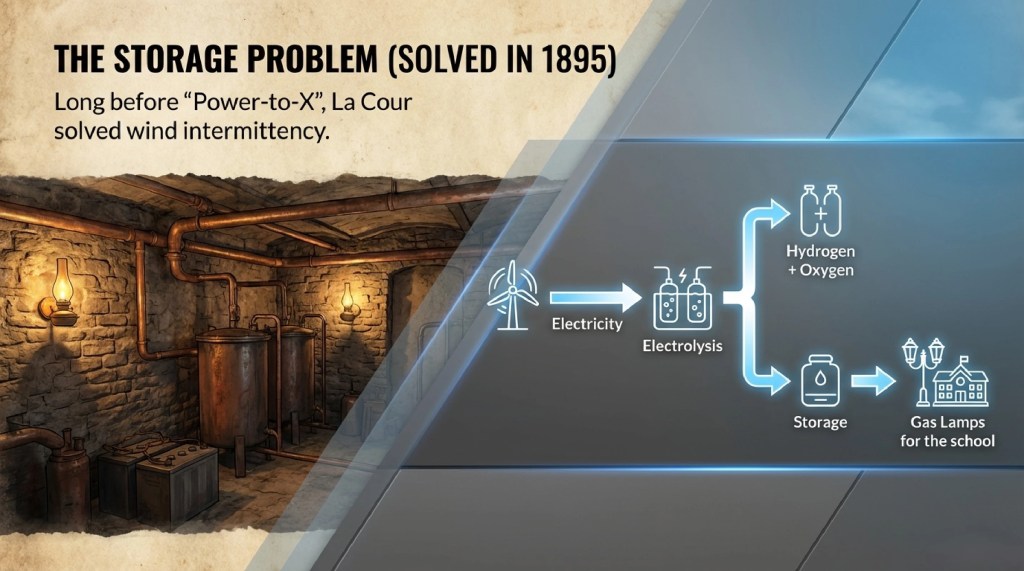
The Storage Problem
Long before the modern concept of “Power-to-X,” Poul la Cour solved the issue of wind intermittency in 1895. He used electricity to perform electrolysis, splitting water into hydrogen and oxygen to provide storage for gas lamps used in schools.
The Modern Archetype
In 1957, Johannes Juul defined the global standard for wind energy with the “Gedser Mill”. This turbine featured three blades for optimal balance, AC generation for grid connection, and stall control using mechanical braking tips. It ran for 10 years without maintenance and became the blueprint for giants like Vestas and Siemens.

Crisis as Catalyst
The 1973 Oil Crisis and the anti-nuclear movement served as the context for the massive “Tvind Turbine” project. Built by a collective of teachers and volunteers over three years, this 53-meter tall structure proved that wind technology could scale to megawatt levels even when the industry claimed it was impossible.

The Garage Pioneers
Henrik Stiesdal and blacksmith Karl Erik Jørgensen pioneered the commercial era by licensing a simple, robust design to Vestas, a farm wagon manufacturer. Their key insight was that the wind industry was born from robust agricultural engineering rather than delicate aerospace technology.

The Scale of Progress
The scale of progress in wind energy is massive, with one modern turbine producing 400 times the output of a 1979 model. While a 1979 Vestas turbine produced 15 kW (powering 1.5 households), a modern Enventus turbine produces 5.6 MW, enough to power over 5,000 households.

A Relay Race of Innovation
The history of wind power is a relay race of innovation, passing from the science of Poul la Cour to the engineering of Johannes Juul, the ambition of the Tvind Team, and the commercialization of Henrik Stiesdal. Today’s industry stands on the shoulders of these giants, having moved from the stone quern to the gigawatt scale.


